Regulating for Resilience: Developing a Multi-level Physiological Framework for Chemical Risk Assessment Under Climate Change

Project Code: COLLINS_PLYM_ARIES27

Regulating for Resilience: Developing a Multi-level Physiological Framework for Chemical Risk Assessment Under Climate Change

Project Code: COLLINS_PLYM_ARIES27

Project Description

Supervisors

Dr Michael Collins, Plymouth Marine Laboratory – contact me 

Dr Manuela Truebano, University of Plymouth

Professor Alex Ford, University of Portsmouth

Professor Mark Fitzsimons, University of Plymouth

Dr Oliver Tills, University of Plymouth and Phenomyx CIC

Dr Luke Holmes, Environment Agency
 

Scientific Background

Coastal regions face the triple threat of emerging contaminants, heatwaves, and deoxygenation. Current chemical risk assessment substantially underestimates ecological risk because pollutants are evaluated in isolation and at the species-level only, overlooking synergistic stressor interactions and population-level variation in tolerance. As a result, concentrations considered safe under existing frameworks may be harmful when combined with future levels of warming and hypoxia. Without accounting for these interacting pressures and natural population variability, risk assessments may fail to predict population declines, biodiversity loss, and ecosystem disruption.


Research Methodology

This interdisciplinary project aims to develop a multi-level, risk assessment framework to evaluate vulnerability of marine invertebrate populations to emerging pollutants under climate change. By combining transcriptomics with computer vision, AI-powered physiological approaches, and linking responses to fitness outcomes, the project will identify mechanisms underpinning population resilience and sensitivity to multiple stressors. This integrative approach will develop a novel, ecologically-realistic framework for predicting chemical risk thresholds under climate change.

Specifically, this project will:

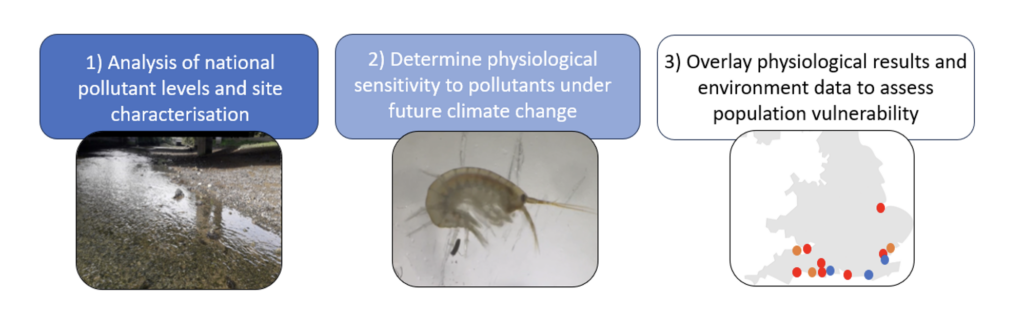
  1. Conduct laboratory-multistressor experiments to quantify physiological tipping points in aquatic invertebrate populations exposed to climate-contaminant combinations, integrating responses across scales including cells, whole-organisms via cutting-edge physiological/behavioural analyses from Phenomyx (PCIC), and population fitness.
  2. Access Environment Agency (EA) datasets, alongside performing analytical chemistry techniques, to characterise habitats and quantify contaminant levels (pharmaceuticals), temperature and oxygen.
  3. Develop a risk assessment tool by integrating tipping points and environmental pharmaceutical levels to predict population vulnerability under climate change.


Training

This pioneering project offers opportunities to work across academia, industry and regulatory bodies, with training in multi-stressor investigation and bioinformatics (Collins); behavioural ecotoxicology (Ford); thermal biology (Truebano); analytical chemistry (Fitzsimons); phenomics (PCIC); and national chemical risk assessment (EA).

Your supervisory team will help identify your training needs and use dedicated ARIES-DTP funding to support your development. You will be supported to lead manuscripts, present at international conferences, and engage in impact-focused activities.


Person Specification

We seek an enthusiastic individual with a background in marine biology or related fields. Experience with laboratory ecophysiology experiments and/or molecular techniques is desirable. A strong interest in physiology, ecotoxicology and climate change, together with excellent quantitative analysis skills, is essential.

Acceptable first degree subject(s): Minimum 2:1 Bachelor’s degree in Marine Biology or Biology

References

  • Wilson, R., Driver, K., Orr, J., Truebano, M., Collins, M., Jackson, M. (2026) Gene-to-population level responses to multiple stressors on the rocky shore, Ecology and Evolution, 16, e73368
  • Ford, A.T., Ågerstrand, M., Börjeson, N., Brodin, T., Brooks, B.W., Maack, G., Lazorchak J.W., Saaristo, M., Wong, B.B. (2025) Perceptions about the use of behavioral (eco)toxicology to protect human health and the environment, Int. Environmental Assessment and Management., vjaf123
  • Bagnis, S., Fitzsimons, M.F., Snape, J., Tappin, A., Comber S. (2018) Processes of distribution of pharmaceuticals in surface freshwaters: implications for risk assessment, Environmental Chemistry Letters, 16, 1193-1216
  • Collins, M., Truebano, M., Verberk, W. and Spicer, J.I. (2021) Do aquatic ectotherms perform better under hypoxia after warm acclimation?, Journal of Experimental Biology, 224, jeb232512
  • Tills, O., Holmes, L.A., Quinn, E., Everett, T., Truebano, M. and Spicer, J.I. (2023) Phenomics enables measurement of complex responses of developing animals to global environmental drivers, Science of the Total Environment, 858, 159555

Key Information

  • This studentship has been shortlisted for funding under the UKRI NERC DLA funding scheme and will commence on 1 October 2027. The closing date for applications is 23:59 on 16 December 2026.
  • Successful candidates who meet UKRI’s eligibility criteria will be awarded a fully-funded studentship, which covers fees, maintenance stipend (£21,805 p.a. for 2026/27) and a research training and support grant (RTSG). A limited number of studentships are available for international applicants, with the difference between 'home' and 'international' fees being waived by the registering university. Please note, however, that ARIES funding does not cover additional costs associated with relocation to, and living in, the UK, such as visa costs or the health surcharge.
  • ARIES postgraduate researchers (PGRs) benefit from bespoke training and ARIES provides £2,500 to every student for access to external training, travel and conferences, on top of all Research Costs associated with the project. Excellent applicants from quantitative disciplines with limited experience in environmental sciences may be considered for an additional 3-month stipend to take advanced-level courses. Excellent applicants from quantitative disciplines with limited experience in environmental sciences may be considered for an additional 3-month stipend to take advanced-level courses.
  • ARIES is committed to equality, diversity, widening participation and inclusion in all areas of its operation. We encourage enquiries and applications from all sections of the community regardless of gender, ethnicity, disability, age, sexual orientation and transgender status. Academic qualifications are considered alongside non-academic experience, and our recruitment process considers potential with the same weighting as past experience.
  • All ARIES studentships may be undertaken on a part-time or full-time basis. International applicants should check whether there are any conditions of visa or immigration permission that preclude part-time study. All advertised project proposals have been developed with consideration of a safe, inclusive and appropriate research and fieldwork environment with respect to protected characteristics. If you have any concerns, please contact us.
  • For further information, please contact the supervisor. To apply for this Studentship, follow the instructions at the bottom of the page or click the 'apply now' link.
  • ARIES is required by our funders to collect Equality and Diversity Information from all of our applicants. The information you provide will be used solely for monitoring and statistical purposes; it will remain confidential and will be stored on the UEA SharePoint server. Data will not be shared with those involved in making decisions on the award of Studentships and will have no influence on the success of your application. It will only be shared outside of this group in an anonymised and aggregated form. You will be asked to complete the form by the University to which you apply.
  • ARIES studentships are subject to UKRI terms and conditions. Postgraduate Researchers are expected to live within reasonable distance of their host organisation for the duration of their studentship. Please see https://www.ukri.org/publications/terms-and-conditions-for-training-funding/ for more information.

Apply Now

For further information on the application process for this studentship, please visit the  University of Plymouth's Research Degrees webpage.