Human Impacts on the Role of Beaches as Fish Nurseries: Advancing Tools to Measure Energy Use and Infer Habitat Quality

Project Code: CIOTTI_PLYM_ARIES27

Human Impacts on the Role of Beaches as Fish Nurseries: Advancing Tools to Measure Energy Use and Infer Habitat Quality

Project Code: CIOTTI_PLYM_ARIES27

Project Description

Supervisors

Dr Benjamin Ciotti, School of Biological and Marine Sciences, University of Plymouth – contact me

Dr Keiron Fraser, University of Plymouth

Professor Clive Trueman, University of Southampton

Dr Mark Rawling, University of Plymouth
 

Scientific Background

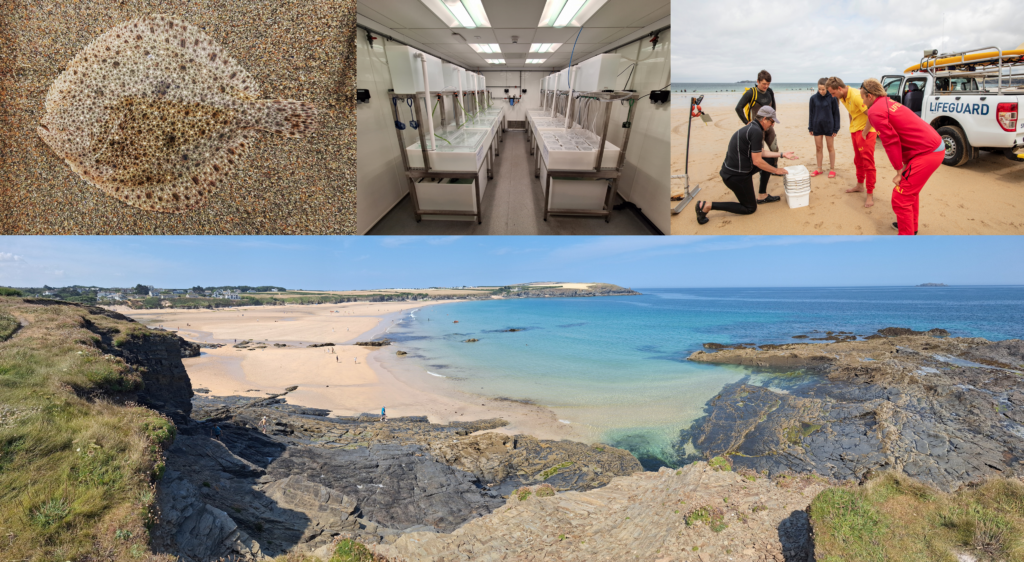
Fisheries and fish biodiversity depend on coastal nurseries which are heavily exposed to human activities. In particular, commercially important flatfish, such as turbot, sole and plaice, rely critically on knee- or waist-deep areas of sandy beaches in their first summer. In heatwaves, these shallows warm rapidly but also receive an influx of beachgoers. Impacts of warming and human disturbance on these coastal nurseries are little studied, but likely include direct feeding interference and thermal stress as well as indirect effects through displacement to suboptimal habitats, ultimately impacting growth, survival and recruitment to the adult population. This project aims to untangle the interactive effects of increased temperature and human disturbance on fish nurseries through applications of state-of-the-art tools, developed at Plymouth and Southampton, for measuring metabolism, growth and stress responses in situ.


Research Methodology

Working at University of Plymouth’s exceptional Brixham Laboratory, the student will explore physiological responses of juvenile turbot to temperature increase under different feeding conditions. Turbot are commercially valuable, locally available, with well-developed husbandry practices; juveniles rely on the most-impacted, shallowest areas of beaches around Plymouth. Physiological traits investigated will include metabolic rate, growth rate, protein synthesis, oxidative stress as well as field proxies for these processes (RNA-based indices, otolith carbon-isotope chemistry). Field investigations using the proxies will then examine influences of warming and human presence on distribution, feeding, growth energetics and stress in situ. Bringing insights from these efforts to an existing long-term beach-sampling dataset, the student will identify drivers of nursery habitat quality and apply this to forecast changes under future scenarios.


Training

The PhD presents an unrivalled opportunity to complement cutting-edge experimental work in controlled aquaria with field approaches, developing a broad, in-demand skillset relevant to contemporary fisheries and conservation management. Training will be provided in field sampling, fish husbandry and advanced analytical approaches that bridge pioneering expertise of the supervisors: biochemical growth and stress indices (Ciotti+Rawling), flooding dose methods to measure protein synthesis (Fraser), geochemical approaches to infer field metabolic rate (Trueman).


Person Specification

Would suit individuals with interests in ecophysiology fisheries/conservation ecology who seek to combine laboratory and field approaches.

Acceptable first degree subject(s): Biological, environmental, marine or related science.

References

  • Ciotti BJ, Brown EJ, Colloca F, Eggleston DB, Hyman AC, Le Pape O, Lipcius RN, Maathuis MAM, Poiesz SSH, Rose KA, Seitz RD, Ventura D, van de Wolfshaar KE (2025) Measuring juvenile habitat quality for fishes and invertebrates. Biological Reviews 100:2346-2395
  • Ciotti BJ, Targett TE, Nash RDM, Batty RS, Burrows MT, Geffen AJ (2010) Development, validation and field application of an RNA-based growth index in juvenile plaice Pleuronectes platessa. J Fish Biol 77:2181-2209
  • Cienfuegos IA, Ciotti BJ, Billington RA, Sutton PA, Fraser KPP (2026) Growth in the margins: Field measured protein metabolism rates in the common limpet, Patella vulgata. Mar Environ Res 213:107658
  • Trueman CN, Artetxe-Arrate I, Kerr LA, Meijers AJS, Rooker JR, Sivankutty R, Arrizabalaga H, Belmonte A, Deguara S, Goñi N, Rodriguez-Marin E, Dettman DL, Santos MN, Karakulak FS, Tinti F, Tsukahara Y, Fraile I (2023) Thermal sensitivity of field metabolic rate predicts differential futures for bluefin tuna juveniles across the Atlantic Ocean. Nature Communications 14 (1):7379 https://doi.org/10.1038/s41467-023-41930-2
  • Rawling M, Schiavone M, Apper E, Merrifield DL, Castex M, Leclercq E, Foey A (2023) Yeast cell wall extracts from Saccharomyces cerevisiae varying in structure and composition differentially shape the innate immunity and mucosal tissue responses of the intestine of zebrafish (Danio rerio). Front Immunol 25;14:1158390.

Key Information

  • This studentship has been shortlisted for funding under the UKRI NERC DLA funding scheme and will commence on 1 October 2027. The closing date for applications is 23:59 on 16 December 2026.
  • Successful candidates who meet UKRI’s eligibility criteria will be awarded a fully-funded studentship, which covers fees, maintenance stipend (£21,805 p.a. for 2026/27) and a research training and support grant (RTSG). A limited number of studentships are available for international applicants, with the difference between 'home' and 'international' fees being waived by the registering university. Please note, however, that ARIES funding does not cover additional costs associated with relocation to, and living in, the UK, such as visa costs or the health surcharge.
  • ARIES postgraduate researchers (PGRs) benefit from bespoke training and ARIES provides £2,500 to every student for access to external training, travel and conferences, on top of all Research Costs associated with the project. Excellent applicants from quantitative disciplines with limited experience in environmental sciences may be considered for an additional 3-month stipend to take advanced-level courses. Excellent applicants from quantitative disciplines with limited experience in environmental sciences may be considered for an additional 3-month stipend to take advanced-level courses.
  • ARIES is committed to equality, diversity, widening participation and inclusion in all areas of its operation. We encourage enquiries and applications from all sections of the community regardless of gender, ethnicity, disability, age, sexual orientation and transgender status. Academic qualifications are considered alongside non-academic experience, and our recruitment process considers potential with the same weighting as past experience.
  • All ARIES studentships may be undertaken on a part-time or full-time basis. International applicants should check whether there are any conditions of visa or immigration permission that preclude part-time study. All advertised project proposals have been developed with consideration of a safe, inclusive and appropriate research and fieldwork environment with respect to protected characteristics. If you have any concerns, please contact us.
  • For further information, please contact the supervisor. To apply for this Studentship, follow the instructions at the bottom of the page or click the 'apply now' link.
  • ARIES is required by our funders to collect Equality and Diversity Information from all of our applicants. The information you provide will be used solely for monitoring and statistical purposes; it will remain confidential and will be stored on the UEA SharePoint server. Data will not be shared with those involved in making decisions on the award of Studentships and will have no influence on the success of your application. It will only be shared outside of this group in an anonymised and aggregated form. You will be asked to complete the form by the University to which you apply.
  • ARIES studentships are subject to UKRI terms and conditions. Postgraduate Researchers are expected to live within reasonable distance of their host organisation for the duration of their studentship. Please see https://www.ukri.org/publications/terms-and-conditions-for-training-funding/ for more information.

Apply Now

For further information on the application process for this studentship, please visit the  University of Plymouth's Research Degrees webpage.