A Scattered Deep Sea: Global Biodiversity Change and Processes Across Hydrothermal Vents

Project Code: ALFARO-LUCAS_PLYM_ARIES27

A Scattered Deep Sea: Global Biodiversity Change and Processes Across Hydrothermal Vents

Project Code: ALFARO-LUCAS_PLYM_ARIES27

Project Description

Supervisors

Dr Joan Alfaro-Lucas, School of Biological and Marine Sciences, University of Plymouth – contact me

Professor Tracy Aze, School of Biological and Marine Sciences, University of Plymouth

Dr Lissette Victorero, Deep Sea Conservation Coalition

Dr Michelle Harris, School of Geography, Earth and Environmental Sciences, University of Plymouth
 

Scientific Background

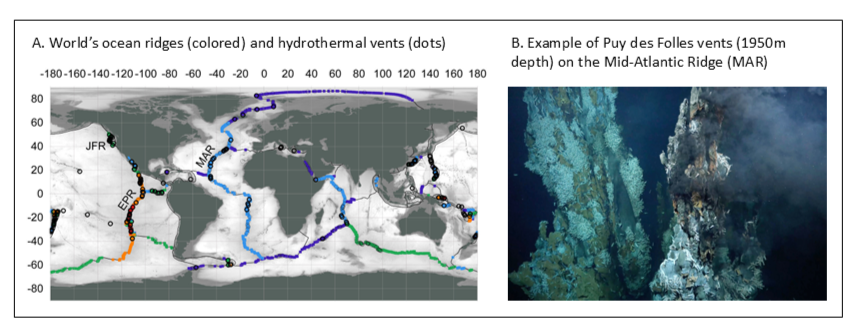
The potential exploitation of deep-sea mineral resources is creating an urgent need for scientifically robust approaches to the conservation of planet’s most remote, remarkable ecosystems, including hydrothermal vents. Vents harbour highly distinct, endemic and vulnerable animal communities patchily distributed along ocean ridges with contrasting geological, physical and geochemical characteristics. Yet identifying representative networks of habitats for protection requires understanding how species and ecological functions change among habitats, and which habitats make unique contributions to biodiversity.

The contrasting environments of ocean ridges provide a powerful global system for investigating the poorly understood patterns and processes driving species and functional diversity change (β-diversity) among scattered habitats in the deep sea, allowing these key knowledge gaps to be addressed.

The central hypothesis of this project is that the distinct attributes of the world’s ocean ridges drive different patterns of species and functional β-diversity in hydrothermal vent ecosystems. Testing this hypothesis will reveal why vent communities become different across space and environmental gradients and provide the evidence to identify representative and complementary habitats for conservation.


Research Methodology

You will analyse an unpublished global database of vent species and their traits compiled by the supervisory team. You will apply state-of-the-art statistical modelling, including distance-decay and joint species distribution models, to test whether geological, physical and geochemical differences among ocean ridges explain contrasting biodiversity patterns and evaluate the relative roles of dispersal limitation and ecological niche sorting. Finally, you will quantify the distinctiveness of vent habitats to identify habitats that contribute the most to species and functional diversity, providing evidence to spatial conservation priorities.


Training

You will join a collaborative, multidisciplinary team of deep-sea scientists and develop expertise in (deep-sea) macroecology; global biodiversity database synthesis and curation; species and functional β-diversity analyses and advanced statistical modelling. This data- and analysis-driven training will develop advanced quantitative and transferable skills relevant to careers across academia and industry.


Person Specification

We seek a perseverant, methodical and enthusiastic individual with a BSc degree in Biology or a related field. An interest in macroecology and strong quantitative analysis skills in R are essential.

Acceptable first degree subject(s): BSc degree in Biology or a related field

References

  • Alfaro-Lucas, J.M., Chapman, A.S.A., Tunnicliffe, V., Bates, A.E. (2024). High functional vulnerability across the world’s deep-sea hydrothermal vent communities. Proceedings of the Natural Academy of Sciences U.S.A. 121, e2403899121. https://doi.org/10.1073/pnas.2403899121
  • Victorero, L., Samadi, S., O'Hara, T.D., Mouchet, M., Delavenne, J., Leprieur, F. and Leroy, B. (2023). Global benthic biogeographical regions and macroecological drivers for ophiuroids. Ecography 9, p.e06627. https://doi.org/10.1111/ecog.06627
  • Fenton, I.S., Aze, T., Farnsworth, A., Valdes, P., Saupe, E.E. (2023). Origination of the modern-style diversity gradient 15 million years ago. Nature 614, 708–712. https://doi.org/10.1038/s41586-023-05712-6
  • Schwarzenbach, E. & Harris, M. (2025). Hydrothermal alteration of the oceanic lithosphere. Treatise of Geochemistry 3rd Edition Vol 2 p1-37 https://doi.org/10.1016/B978-0-323-99762-1.00016-4
  • Glover, A., Arias, M.B., Bribiesca-Contreras, G., Copley, J.T., Dahlgren, T.G., Drazen, J.C., Drennan, R., Ingels, J., Jones, D.O.B., O'Malley, B.J., Rabone, M., Stewart, E.C.D. (2026). The environmental impacts of deep-sea mining. Current Biology 36. https://doi.org/10.1016/j.cub.2026.03.014

Key Information

  • This studentship has been shortlisted for funding under the UKRI NERC DLA funding scheme and will commence on 1 October 2027. The closing date for applications is 23:59 on 16 December 2026.
  • Successful candidates who meet UKRI’s eligibility criteria will be awarded a fully-funded studentship, which covers fees, maintenance stipend (£21,805 p.a. for 2026/27) and a research training and support grant (RTSG). A limited number of studentships are available for international applicants, with the difference between 'home' and 'international' fees being waived by the registering university. Please note, however, that ARIES funding does not cover additional costs associated with relocation to, and living in, the UK, such as visa costs or the health surcharge.
  • ARIES postgraduate researchers (PGRs) benefit from bespoke training and ARIES provides £2,500 to every student for access to external training, travel and conferences, on top of all Research Costs associated with the project. Excellent applicants from quantitative disciplines with limited experience in environmental sciences may be considered for an additional 3-month stipend to take advanced-level courses. Excellent applicants from quantitative disciplines with limited experience in environmental sciences may be considered for an additional 3-month stipend to take advanced-level courses.
  • ARIES is committed to equality, diversity, widening participation and inclusion in all areas of its operation. We encourage enquiries and applications from all sections of the community regardless of gender, ethnicity, disability, age, sexual orientation and transgender status. Academic qualifications are considered alongside non-academic experience, and our recruitment process considers potential with the same weighting as past experience.
  • All ARIES studentships may be undertaken on a part-time or full-time basis. International applicants should check whether there are any conditions of visa or immigration permission that preclude part-time study. All advertised project proposals have been developed with consideration of a safe, inclusive and appropriate research and fieldwork environment with respect to protected characteristics. If you have any concerns, please contact us.
  • For further information, please contact the supervisor. To apply for this Studentship, follow the instructions at the bottom of the page or click the 'apply now' link.
  • ARIES is required by our funders to collect Equality and Diversity Information from all of our applicants. The information you provide will be used solely for monitoring and statistical purposes; it will remain confidential and will be stored on the UEA SharePoint server. Data will not be shared with those involved in making decisions on the award of Studentships and will have no influence on the success of your application. It will only be shared outside of this group in an anonymised and aggregated form. You will be asked to complete the form by the University to which you apply.
  • ARIES studentships are subject to UKRI terms and conditions. Postgraduate Researchers are expected to live within reasonable distance of their host organisation for the duration of their studentship. Please see https://www.ukri.org/publications/terms-and-conditions-for-training-funding/ for more information.

Apply Now

For further information on the application process for this studentship, please visit the  University of Plymouth's Research Degrees webpage.