Project background
Scientific Background
Mountains and hills (or “orography”) have a substantial effect on the atmospheric circulation, including both local weather systems and the global circulation. Consequently, it is vital that the effects of orography are represented accurately in numerical weather prediction (NWP) models used by the UK Met Office, such as the Unified Model (MetUM).
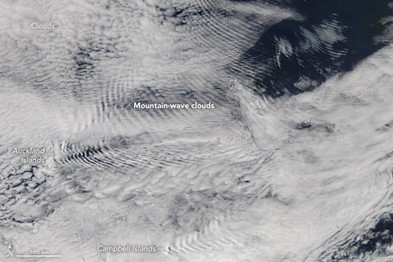
One of the main ways that orography can disturb the atmospheric circulation is by exerting a frictional drag force, which is generated by winds flowing over orography. This creates atmospheric disturbances known as orographic gravity waves. These waves propagate upwards and eventually become unstable and break down, which results in orographic gravity wave drag. This is a frictional force that decelerates upper-level winds and also causes clear-air turbulence. However, a lack of observational understanding of these processes results in their poor representation in NWP models such as the MetUM. This subsequently leads to large errors in the atmospheric circulation simulated by these models, and thus weather forecasts.
Due to the importance of this problem, a major international atmospheric research programme called TEAMx took place over the Alps in 2025, which included intensive summer and winter measurement campaigns. This included measurements from aircraft and weather balloons of orographic gravity waves.
Research Methodology
In this project, the individual will use the measurements from the TEAMx campaign to investigate how orographic gravity waves are generated, and how they propagate upwards and eventually break down. In particular, they will analyse the radiosonde observations to identify case study periods and run sub-km scale simulations of these periods using the MetUM. Examination of case study periods for summer could be especially interesting, as the formation of orographic gravity waves during summer is under studied. Outputs from the MetUM simulations will then be compared with the observations to assess how realistically the model can capture the flow / orographic gravity waves. The simulations will also be used to quantify the vertical and horizontal distribution of orographic drag, and how this depends on flow characteristics (e.g., wind direction, wind shear, boundary layer).