Project background
Scientific Background
The international TEAMx programme presents the opportunity for a step-change in accurately simulating and forecasting orographic flows (weather systems over mountainous regions) – providing the tools needed for addressing open questions on governing processes and their representation in models.
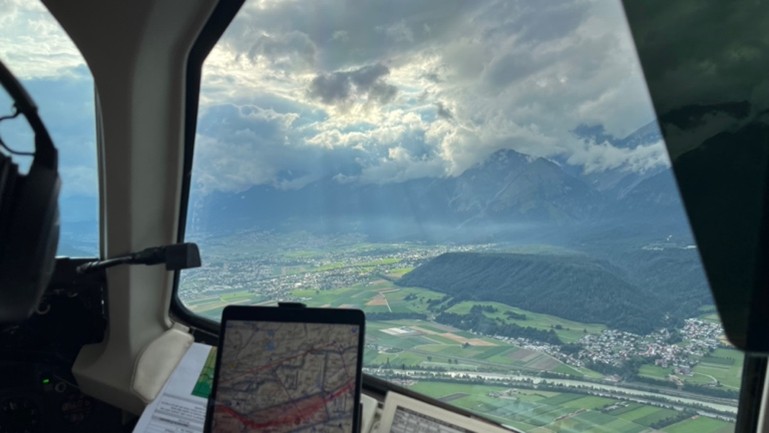
TEAMx coordinated and hosted an unprecedented observational network over the European Alps for over a year, focused on 2025, with several intensive periods, and with the UK committed to a major contribution. The observational novelty comes from the design to comprehensively sample across multiple scales. From local-scales, depending on well-equipped single sites; to district- and regional-scales, depending on ground-based remote sensing, networks of sites and research aircraft; to country- and mountain-range-scales, knitting together massive networks of sites and observations from multiple co-ordinated research aircraft. We now have the task of exploiting these world-class data sets.
Research Methodology
This REP will focus on using wind profiles from ground-based doppler LIDARS from various sites in Austria and Italy to evaluate the quality of numerical weather prediction model simulations. The observations have already been made. Part of the REP will be learning how to (i) quality control, (ii) visualise, (iii) interpret and (iv) use as validation data sets. Two data sets are from the UK team, and several others will be obtained from Austrian and German collaborators (arrangements are already in place).
The model simulations include preexisting operational forecasts and those being run by a team of UK researchers (including at UEA). The REP will have access to these simulations via national high performance computing facilities. Guidance in working with the model output will be provided to enable (i) data extraction, (ii) visualisation, (ii) statistical evaluation against the observations.
The objective of the REP will be to assess the quality of the model simulations of several orographic flow periods during the Summer and (if time allows) Winter intensive observational periods. The REP will join a research team at UEA consisting of a Principal Investigator (Ian Renfrew), a researcher co-investigator (Dan Smith) and a senior research associate (Jack Mustafa), so they will be well supported. The student will have the opportunity to help define the periods of model assessment and will work to establish under what meteorological conditions the model performs well or less well. This will involve sampling the data sets for different conditions and likely bring in other sources of observational data sets too – for example, standard meteorological observations of wind, temperature, humidity, surface fluxes (etc) from ground-based stations.
The REP will be executed in collaboration with Peter Sheridan from the Met Office. Peter led the Met Office’s quasi-operational forecasting support of the TEAMx field campaign in 2025 and is already collaborating with the UK team. Peter will provide specialist knowledge and technical support for this placement opportunity. UEA is now part of the Met Office Academic Partnership and this REP will demonstrate a tangible contribution to that fledging partnership.