Automated isotope ratio mass-spectrometric analysis of dissolved oxygen REP 2026

Automated isotope ratio mass-spectrometric analysis of dissolved oxygen REP 2026

Lead Supervisor:
Jan Kaiser

Locations:
University of East Anglia

Duration:
6-10 weeks

Suitable undergraduate degrees:
Chemistry, Engineering, Environmental Sciences, Natural Sciences, Physics

GO back

Project background

Scientific Background

Measurements of oxygen-to-argon ratios and oxygen isotope ratios in dissolved oxygen (O2) provide powerful constraints on marine net and gross biological production.

These approaches require exceptionally high-precision mass-spectrometric isotope ratio measurements and rigorously reproducible sample handling to minimise analytical bias. The Stable Isotope Laboratory in the School of Environmental Sciences at UEA is currently the only facility in the UK and Europe capable of performing these analyses.

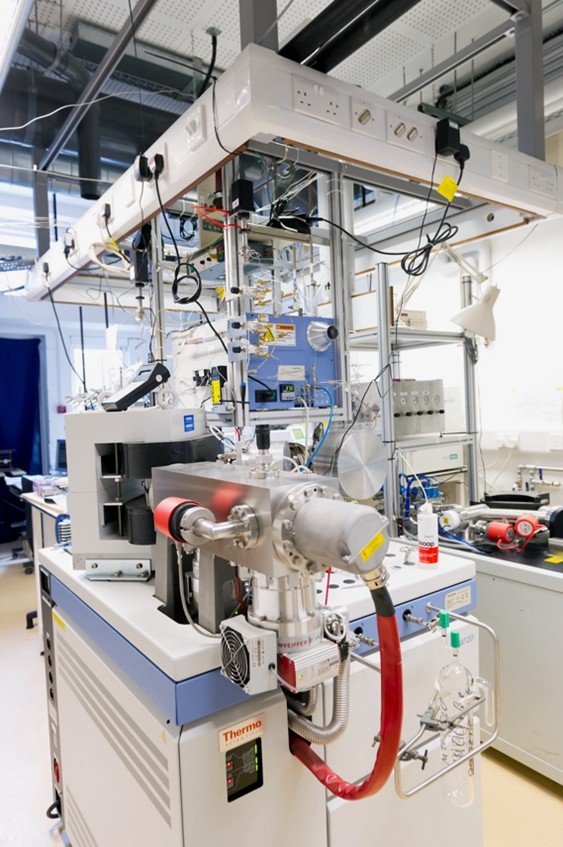
This project aims to develop and implement an automated system for the extraction and purification of dissolved oxygen from water samples, followed by online, coupled gas chromatographic–mass spectrometric analysis. The student will work under the supervision of Prof. Jan Kaiser, in close collaboration with staff of the ENV Stable Isotope Laboratory. A central component of the project will be the development of automated processing routines using a simple scripting language (ISL), alongside any required modifications to electronic and pneumatic instrumentation.


Research Methodology

Once validated, the automated method will be applied to archived samples collected during a research cruise in the Southern Ocean. This will give the student hands‑on experience with all stages of this unique approach to quantifying marine biological production, from analytical method development through to data interpretation in an environmental context. There will also be scope for a peer‑reviewed publication arising from the work.

The precise focus and balance of the project can be tailored to match the student’s interests, skills and career aspirations.
Eligibilty criteria

Students must meet all of the eligibility requirements listed below to apply for a REP:

  • Be undertaking their first undergraduate degree studies (or integrated Masters) – note that students in in their final year who have graduated and no longer have student status at the time the placement starts are not eligible;
  • Be eligible for subsequent NERC PhD funding (please see the relevant text in the ‘Terms and conditions for training funding’ and associated guidance for further information – https://www.ukri.org/publications/terms-and-conditions-for-training-funding/); and
  • Have the right to work in the UK.


Students from outside the UK who do not already have right to work in the UK should not apply.

How to apply

The deadline for applications will be midday (12 noon BST) on Wednesday 20 May 2026.  

In order to be considered for a placement, please apply to aries.dtp@uea.ac.uk providing the following:

  • A supporting statement explaining your motivation for applying for this project. Please include answers to the following questions:
    • which project are you applying for?
    • why have you applied for this project (e.g. what interested you about this project, what in particular made you want to undertake this research)?
    • what do you hope to achieve by undertaking this placement (e.g. is it for experience, to gain skills, to develop your interests)?
    • what skills do you have that make you an ideal candidate for this placement (e.g. what skills have you developed during your degree that might apply)?
    • what do you hope to do when you complete your degree (e.g. have you considered a working in scientific research in the future, or is this your first experience)?
  • A recent CV
  • A reference from your personal tutor (please ask your tutor to send this to us directly)
  • An interim transcript if available
  • Please also complete the online EDI form (this form is a mandatory part of the application process, but contains ‘prefer not to say’ options for all questions asked)
Selection process
  • Applications are screened for eligibility
  • Applications are forwarded to supervisors (the EDI form is not included)
  • Supervisors shortlist candidates and interview for the placement.


Candidates will be scored according to the following criteria:

  • Fit to project (e.g. your current skills, area of study, interests)
  • Enthusiasm for environmental research (e.g. what you hope to achieve through undertaking this placement, why you chose this project in particular)
  • Evidence of suitability to undertake a research placement (e.g. evidence from your tutor reference, transcript, and CV that you are an engaged student)


Successful candidates will be informed by Friday 12 June 2026.